
As an Amazon Associate, AddWatch earns from qualifying purchases. This does not affect our reviews.
The Orient Kamasu is the automatic dive watch we point most people to when they want real specs for little money: an in-house automatic movement, a sapphire crystal and 200 meters of water resistance, usually for $250 to $380. In this Orient Kamasu review we cover the specs, sizing, every common color including the red dial, the new Kamasu GMT and the watches worth comparing it with.
Short answer: buy it if you want one sturdy steel diver for daily wear and your wrist is about 6.5 inches or larger. Skip it if you want a thin watch or chronometer-level accuracy.
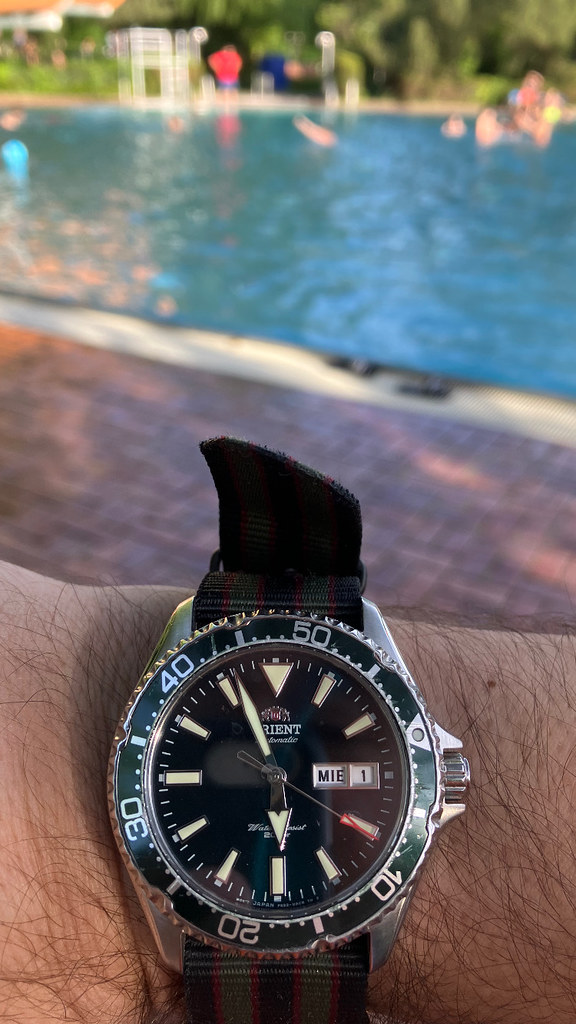
Orient Kamasu at a glance
- Movement: Orient F6922 automatic with hand-winding and hacking, about 40 hours of power reserve
- Case: 41.8 mm stainless steel, 12.8 mm thick, about 47 mm lug to lug
- Crystal: sapphire
- Water resistance: 200 m (660 ft) with a screw-down crown
- Bezel: 120-click unidirectional
- Usual price: $250 to $380
- Best for: one watch for work, weekends and swimming
Orient Kamasu specs
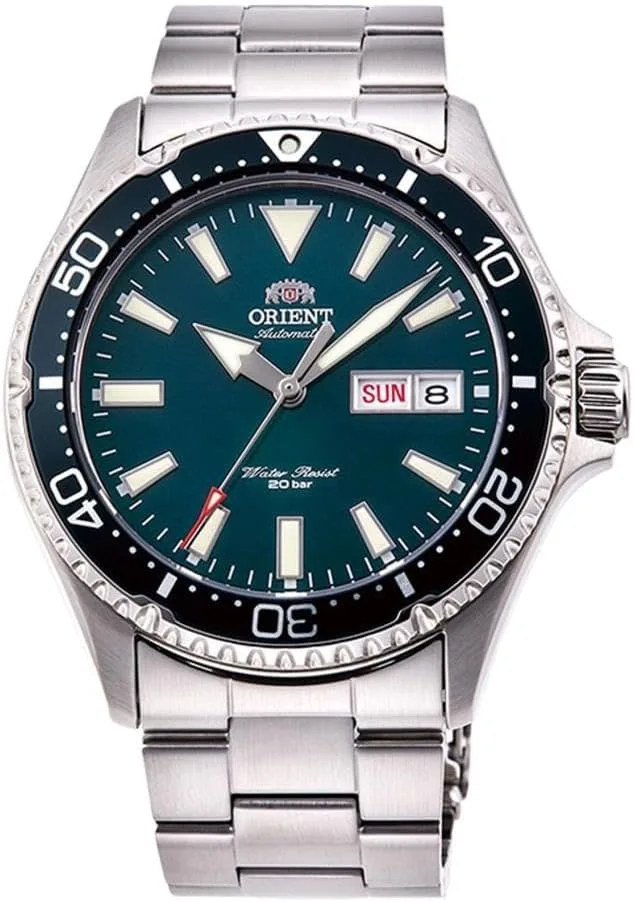
The Orient Kamasu watch is a 41.8 mm steel diver with sapphire, 200 m water resistance and Orient's own F6922 automatic caliber. Here are the full specs for the standard model.
| Spec | Kamasu |
|---|---|
| Core references | RA-AA0001B, RA-AA0002L, RA-AA0003R, RA-AA0004E |
| Movement | Orient F6922, automatic, hand-winding, hacking |
| Beat rate and jewels | 21,600 vph, 22 jewels |
| Power reserve | About 40 hours |
| Rated accuracy | +25 to -15 seconds per day |
| Case diameter | 41.8 mm (1.65 in) without crown |
| Thickness | 12.8 mm (0.50 in) |
| Lug to lug | 46.8 to 47 mm (about 1.85 in) |
| Lug width | 22 mm |
| Crystal | Sapphire |
| Water resistance | 200 m (660 ft) |
| Crown | Screw-down |
| Bezel | Steel, 120-click unidirectional |
| Calendar | Day and date |
| Bracelet | Steel, fold-over clasp with double push-button safety |
| Introduced | 2019 |
Orient lists the lug-to-lug length as 46.8 mm on some spec sheets and 47 mm on others, so treat the two figures as the same measurement rounded differently. Orient USA describes the 200 m rating as suitable for skin diving, and the watch is not certified to the ISO 6425 diver standard.
Orient Kamasu versions and colors
The standard Kamasu comes in four core colors (black, blue, red and green) that share the same case, movement and bracelet. Later editions add Arabic numerals, two-tone bezels and limited dials, but the specs stay the same.
The name is Japanese for barracuda. Orient files the watch inside its Mako family, which is why many shops and owners call it the Mako III, and it arrived in 2019 as a step up from the Mako II. Orient itself has been part of Seiko Epson since 2009, so the brand is related to Seiko but builds its own movements.
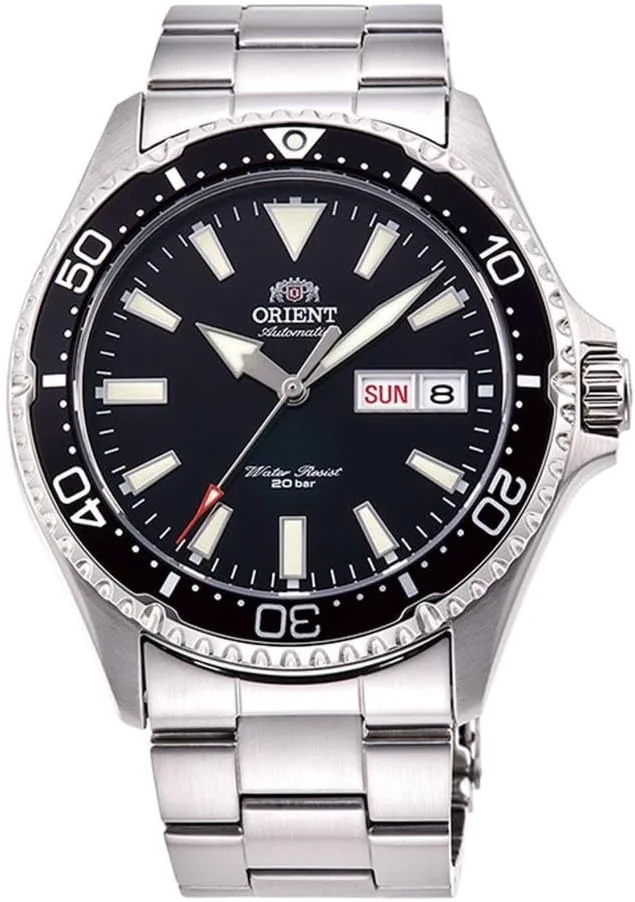
A quick way to read a listing: the letter after the four digits gives the dial color. B is black, L is blue, R is red and E is green. Always compare the reference in the listing with the photos, because the same color can come with different bezels.
Orient Kamasu red
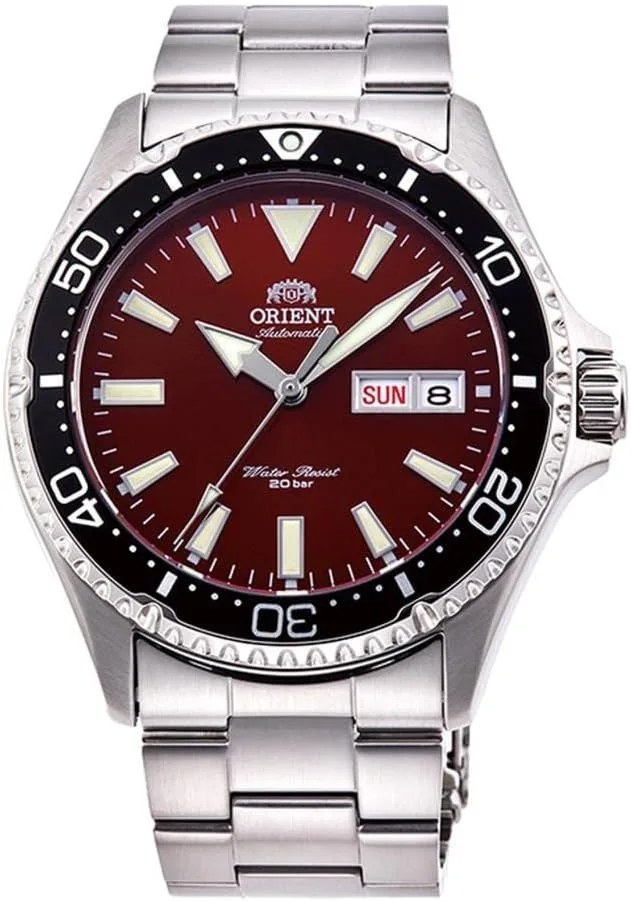
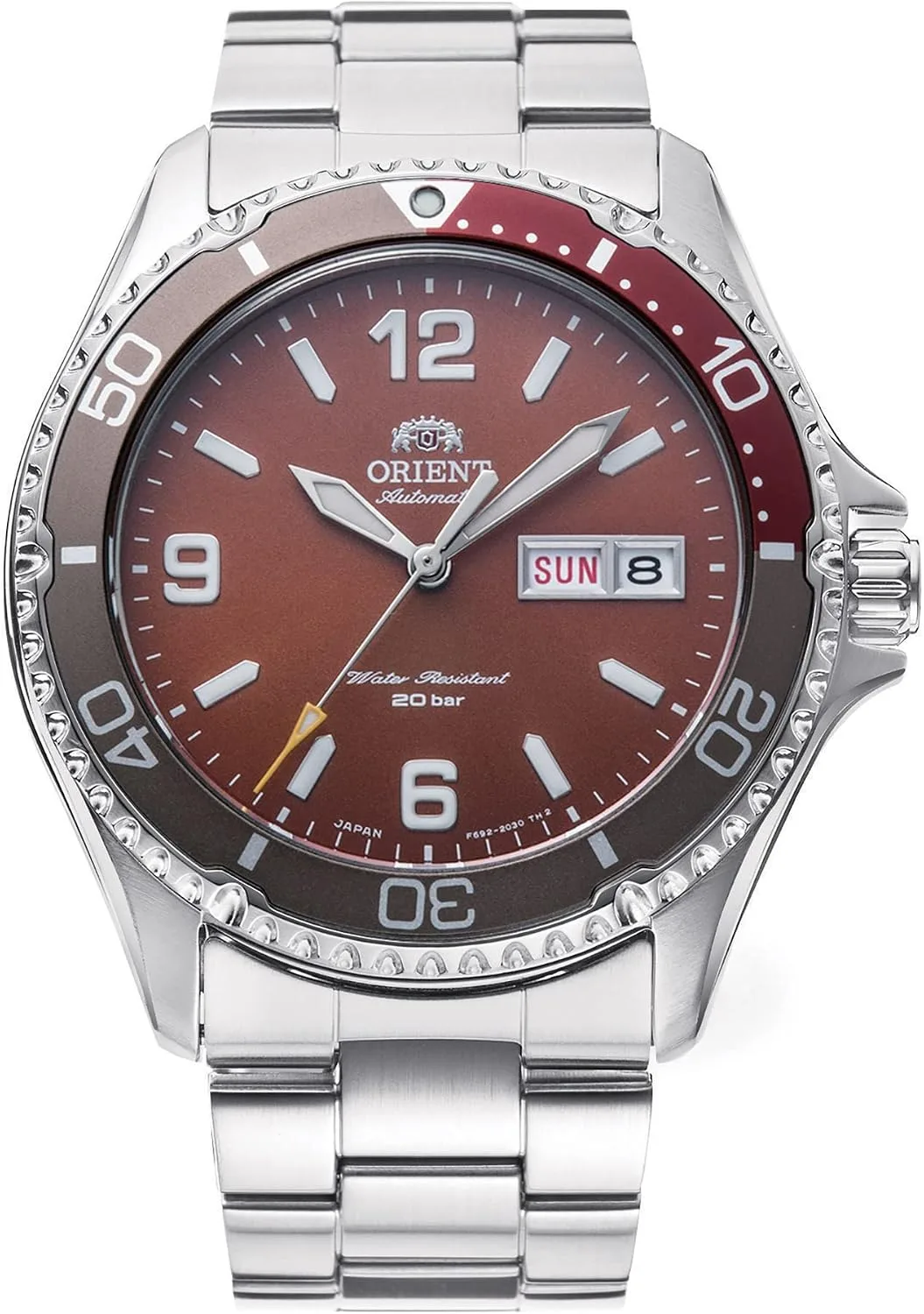
The Orient Kamasu red (RA-AA0003R) pairs a red sunburst dial with a black bezel, and it is the most distinctive of the four core colors. Indoors the red dial reads darker, close to burgundy, and it turns bright red in direct light. It is also one of the most rated Kamasu listings on Amazon. Orient has made separate burgundy editions as well, such as the RA-AA0814R, so check the reference if you want the classic red dial.
Green, blue and black
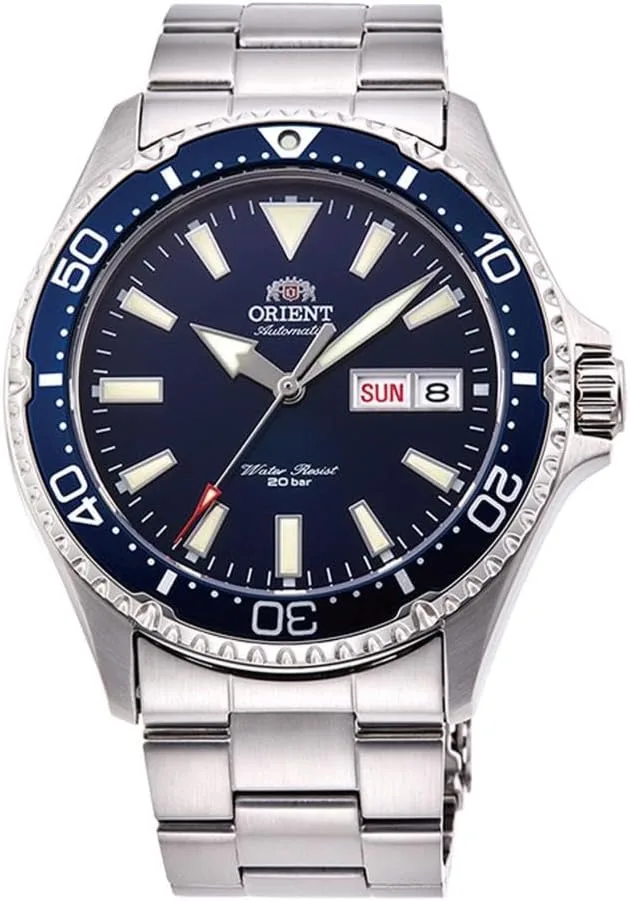
The green Kamasu (RA-AA0004E) is the version we use in our value picks. It has a deep green sunburst dial and appears with either a black or a matching green bezel, depending on the listing. The blue RA-AA0002L uses a blue dial with a blue bezel. The black RA-AA0001B is the most understated option, with a black bezel and a red tip on the seconds hand, and it is the easiest to pair with any strap.
Special editions
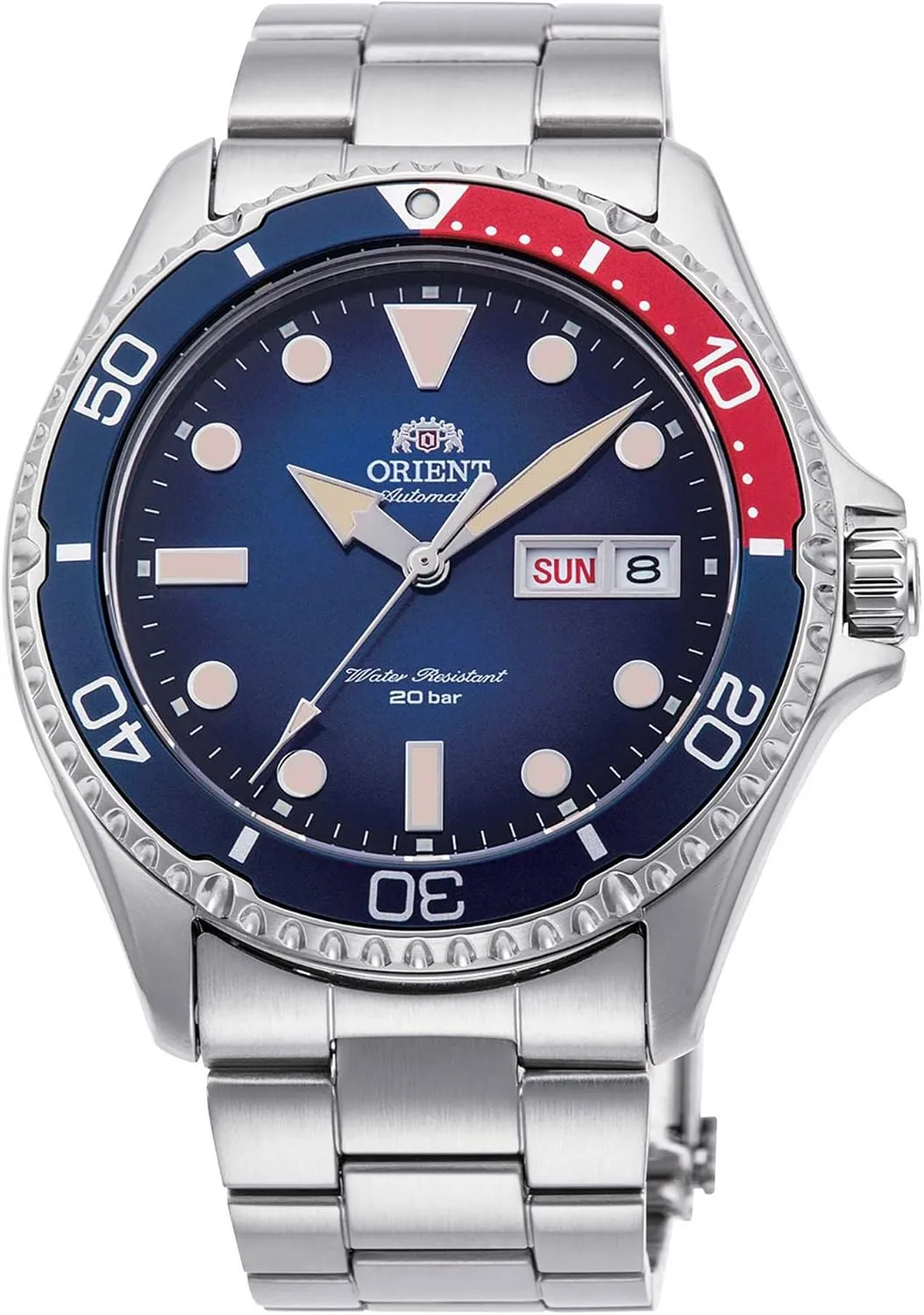
Orient keeps adding Kamasu variants on the same platform. The RA-AA0812L combines a blue dial with a blue and red bezel. The RA-AA0820R uses a brown sunburst dial with Arabic numerals and a brown and red bezel, and the RA-AA0819N does the same in dark gray. The 75th Anniversary Kamasu (RA-AA0823L) carried a $630 regular price at Orient USA. For autumn and winter 2026, Orient brought the Kamasu back with new dial colors, including a limited purple version.
Orient Kamasu size and fit
The Orient Kamasu size is moderate for a dive watch: 41.8 mm across, about 47 mm lug to lug and 12.8 mm thick. Those dimensions suit most wrists from about 6.5 to 7.5 inches, and the short lugs help it sit flat.
| Wrist size | How the Kamasu fits |
|---|---|
| Under 6.25 in (16 cm) | The lugs reach the edges of the wrist; a smaller diver will look better |
| 6.25 to 6.75 in (16 to 17 cm) | Fits well, especially on a strap |
| 6.75 to 7.5 in (17 to 19 cm) | The sweet spot for this case |
| Over 7.5 in (19 cm) | Wears modestly; the Kanno or Kamasu GMT give more presence |
The Orient Kamasu lug width is 22 mm, the most common size for dive watches, so straps are easy to find. On the wrist, owners often say it wears smaller than the 41.8 mm figure suggests because the lugs are short and curve down. The 12.8 mm height is the part you notice: it fits under most shirt cuffs but not under a tight dress cuff.
Design and build quality
The Kamasu looks and feels more expensive than its price because of three details: the sapphire crystal, the sharp bezel action and the sunburst dials. It is a traditional diver layout with no gimmicks.
The Kamasu bezel turns one way through 120 clicks, which allows half-minute steps instead of the 60 clicks found on many budget divers. Owners consistently praise the firm, precise action. The dial mixes rectangle and trapezoid markers with a triangle at 12, which is what gives the Kamasu its toothy look and helps you read it at a glance. The day-date window sits at 3 o'clock, next to a screw-down crown.
The steel case is mostly brushed, and the caseback is solid steel rather than a display window. Orient uses its own luminous paint on the hands and markers. Owners describe the glow as clear after dark but shorter-lived than Seiko's LumiBrite, so it is fine for checking the time at night rather than reading it through a long dive.
Movement and accuracy
The Orient Kamasu movement is the F6922, an automatic caliber Orient makes in-house. It hacks (the seconds hand stops when you pull the crown) and winds by hand, which many watches at this price still skip.
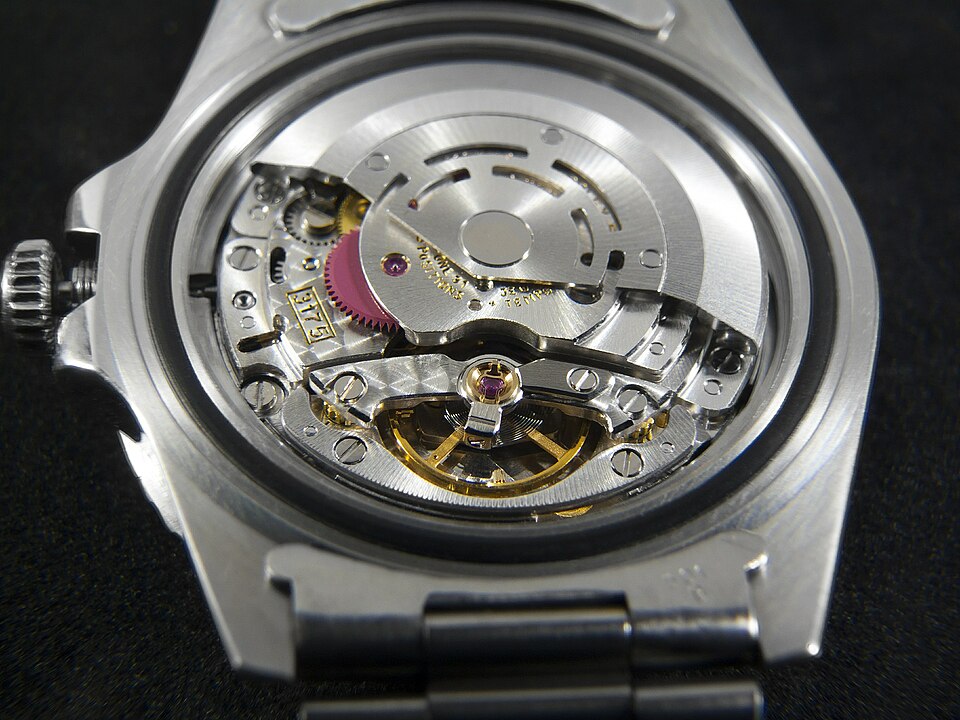
The F6922 beats at 21,600 vibrations per hour, uses 22 jewels and stores about 40 hours of power, so a watch left off over a weekend will usually need resetting by Monday. Orient rates it at +25 to -15 seconds per day. That is a wide range, and individual watches vary; many owners report results well inside it, while others see a unit run fast at first and settle after a few weeks of wear. The same caliber powers the Mako II, Ray II and Kanno, which makes parts and servicing straightforward.
Day and date both quick-set from the crown. As with most mechanical calendars, avoid changing the date between roughly 9 p.m. and 3 a.m., when the date wheel is already engaged. If you are new to automatics, our guide to the mechanical watch explains winding, power reserve and accuracy in more detail.
Water resistance: is the Kamasu a real diver?
Yes, the Orient Kamasu diver works as a real water watch for swimming, snorkeling and recreational diving. It has a 200 m (660 ft) rating, a screw-down crown and a unidirectional timing bezel, which are the basic features a dive watch needs.
What it lacks is ISO 6425 certification, the standard that tests divers for things like shock, magnetism and lume visibility. Orient USA labels the rating as appropriate for skin diving, so the Kamasu is a capable swimming and snorkeling watch rather than professional equipment. Practical care is simple:
- Screw the crown down fully before the watch touches water
- Never pull or turn the crown while the watch is wet
- Rinse it in fresh water after the sea or a chlorinated pool
- Have the gaskets checked when the watch is serviced, roughly every five years
Bracelet and straps
The Kamasu comes on a steel bracelet with a fold-over clasp and a double push-button safety. The links are fully brushed, which suits the tool-watch look and hides scratches well.
The bracelet is the area where Orient saved money. The end links are hollow, and the clasp is a simple stamped design, so it feels lighter and less refined than the case. Owners who want a sportier feel often swap it for rubber or a NATO strap, and the 22 mm lug width makes that easy. The watch in our photo above wears a NATO, which also cuts weight for swimming. Our NATO watch strap guide covers sizes and fitting.
Orient Kamasu GMT (2026)
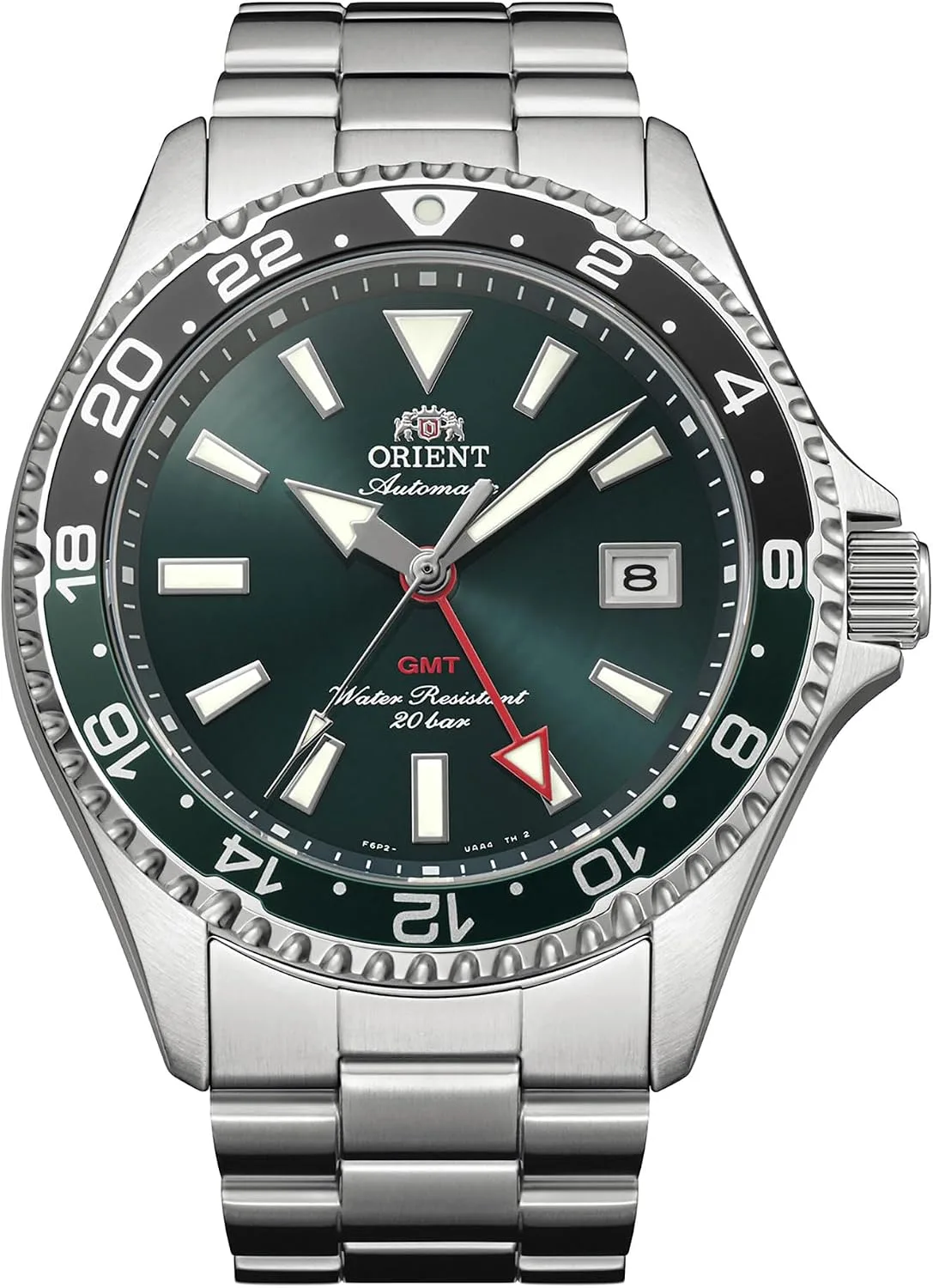
The Orient Kamasu GMT is the newest member of the family, released in autumn 2026, and it adds a 24-hour hand and a 24-hour bezel for tracking a second time zone. It is also the answer to most "orient gmt" searches right now.
The GMT is larger than the standard model: 42.8 mm wide, 13.4 mm thick and 49.5 mm lug to lug. It uses a new F6P22 automatic caliber with hacking, hand-winding and more than 40 hours of reserve, keeps the sapphire crystal and the 200 m rating, and drops the day window. Regular versions come in black, green, blue and orange, plus a limited dark blue edition. Orient set the regular price at $625 and launched it at $495 in its US store. Reports differ on how the 24-hour hand is set, so frequent travelers should check Orient's manual before buying. Outside the US, the same design is sold as the Orient Mako GMT. For one time zone, the standard Kamasu remains the better value.
Orient Kamasu alternatives
The Kamasu's closest rivals come from Orient itself. The Kanno, Mako II and Ray II all share the F6922 movement, while Seiko offers similar money for a different style.
| Watch | Movement | Case | Crystal | Water resistance | Usual price |
|---|---|---|---|---|---|
| Kamasu | Orient F6922 | 41.8 mm | Sapphire | 200 m | $250 to $380 |
| Orient Kanno | Orient F6922 | About 44 mm | Mineral | 200 m | A little below the Kamasu |
| Orient Mako II | Orient F6922 | 41.5 mm | Mineral | 200 m | $180 to $280 |
| Seiko 5 Sports SRPD55 | Seiko 4R36 | 42.5 mm | Hardlex | 100 m | $220 to $300 |
| Seiko Prospex Turtle SRPE93 | Seiko 4R36 | 45 mm | Hardlex | 200 m | $300 to $450 |
| Kamasu GMT | Orient F6P22 | 42.8 mm | Sapphire | 200 m | $495 to $625 |
Orient Kamasu vs Orient Kanno
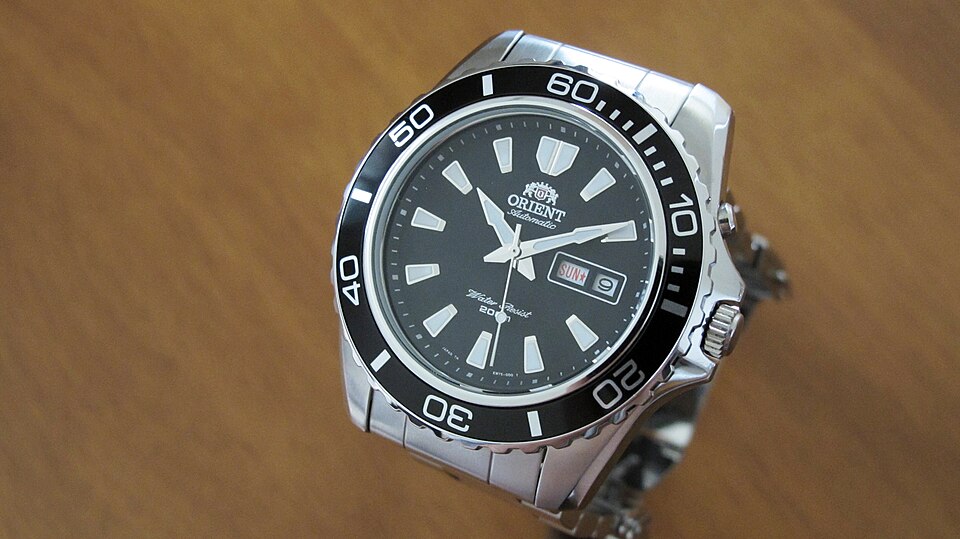
The Orient Kanno is the bigger, simpler sibling. It launched in 2018, measures about 43.6 to 44 mm wide and roughly 50 mm lug to lug, and uses a mineral crystal instead of sapphire. It shares the F6922 movement and the 200 m rating, but its bezel is plainer and its markers are simple rectangles. Choose the Kanno for a large wrist on a tighter budget; choose the Kamasu for sapphire and the better finished bezel.
Kamasu vs Mako II and Ray II
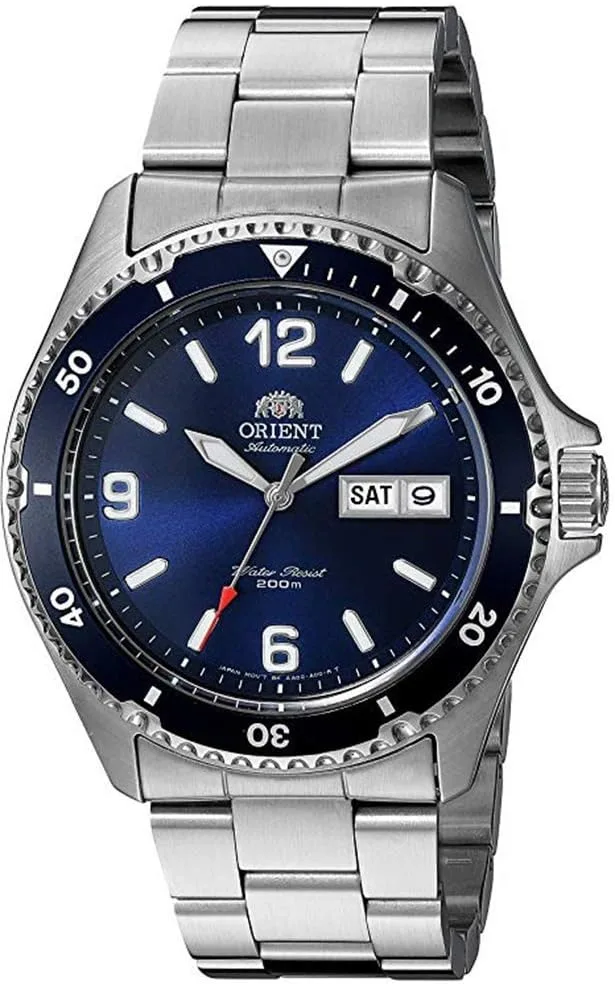
The Mako II and Ray II are the older, cheaper Orient divers on the same caliber. Both are 41.5 mm with mineral crystals, and they also have 120-click bezels, so the main reason to pay more for the Kamasu is the scratch-resistant sapphire crystal and its sharper dial design. If you mostly wear a watch on weekends and do not mind a mineral crystal, the Mako II saves money. Our Casio Duro review also compares these Orient divers with a quartz option at a fraction of the price.
Seiko alternatives
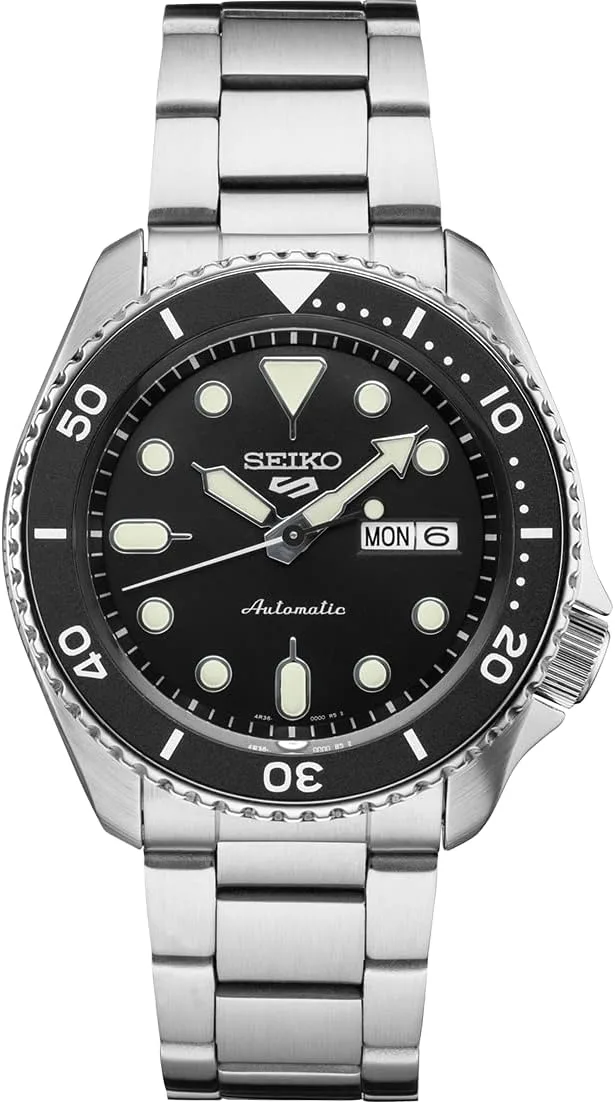
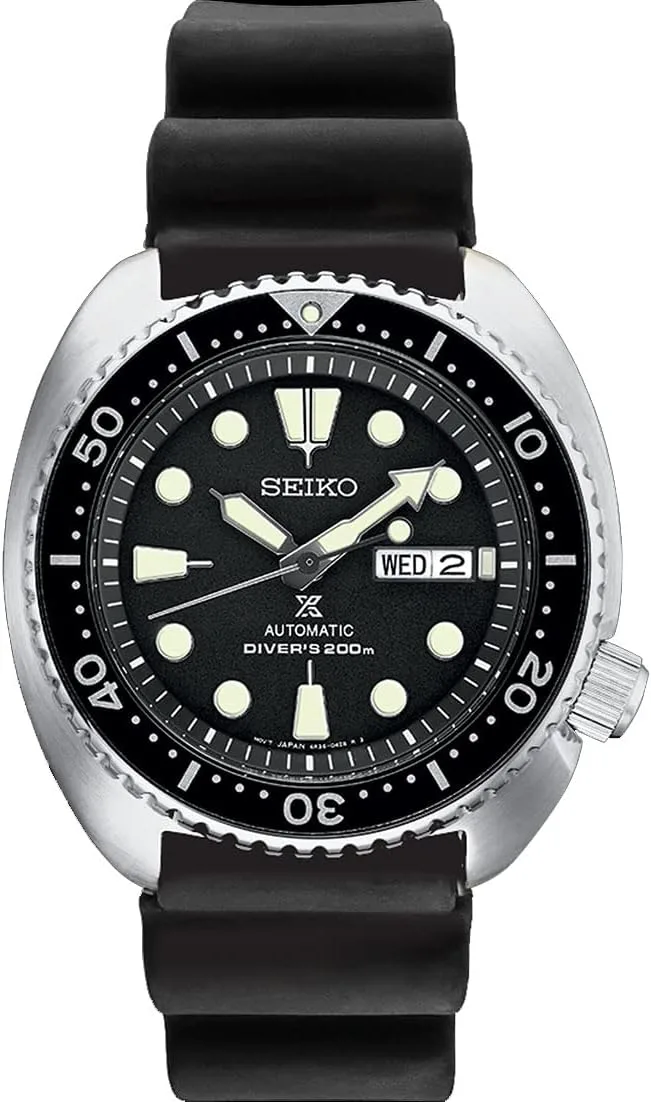
The Seiko 5 Sports SRPD55 costs about the same, offers a display caseback and a huge range of colors, but has 100 m of water resistance and a Hardlex crystal; see our Seiko 5 Sports review. The Seiko Prospex Turtle is a true 200 m Prospex diver with a cushion case, but it is larger at 45 mm and costs more. For how the two Japanese giants compare overall, read Seiko vs Citizen.
What owners say about the Kamasu
Owner feedback on the Kamasu is strongly positive, with thousands of ratings across its colors averaging around 4.5 stars or higher on Amazon. The praise and the complaints are consistent.
What holds up:
- The sapphire crystal stays clear after years of daily wear
- The 120-click bezel feels firm and precise
- The green and red sunburst dials look more expensive in person than in photos
- The overall value: many owners call it the best diver they have bought for the money
Common complaints:
- Accuracy varies from watch to watch, and some run fast when new
- The lume is good but fades faster than Seiko's
- Hollow end links and a basic stamped clasp
- Some owners report the bezel pip sitting slightly off the 12 o'clock marker
- At 12.8 mm it is thicker than some buyers expect
Price and value
The Kamasu usually sells for $250 to $380, depending on color and seller, while limited editions and the 75th Anniversary model cost more. The Kamasu GMT sits higher at $495 to $625.
At the standard price, very few watches combine an in-house automatic, sapphire and a 200 m rating with a screw-down crown. The Seiko 5 Sports costs the same but gives up sapphire and half the water resistance, and the Seiko Turtle costs more with a mineral-type Hardlex crystal. That is why the Kamasu tops our list of the best watches under $500 and is our overall pick for the best watch for the money.
Check the Kamasu price on AmazonPros and cons
Pros:
- Sapphire crystal at a price where most rivals use mineral glass
- 200 m water resistance with a screw-down crown
- In-house F6922 automatic with hacking and hand-winding
- Crisp 120-click bezel
- Attractive sunburst dials in many colors
- 22 mm lugs that take almost any strap
Cons:
- Rated accuracy of +25 to -15 seconds per day is loose
- About 40 hours of power reserve
- Bracelet clasp and hollow end links feel cheap next to the case
- Lume is average
- 12.8 mm thick, so it is not a dress watch
Who should buy the Orient Kamasu
The Kamasu is for buyers who want one durable, good-looking automatic that can handle the office, the beach and the pool. It also makes an excellent first serious watch for someone moving up from quartz.
Skip it if:
- Your wrist is under about 6.25 inches and you prefer a compact watch
- You need accuracy within a few seconds a day; a quartz or solar watch is better
- You want a display caseback to watch the movement
- You travel often and want a second time zone; look at the Kamasu GMT instead
How we evaluated the Kamasu
We have not tested the Kamasu on our own wrists for this review. Instead, we compared Orient's official specifications across several references, checked them against authorized dealer listings, read a large sample of owner reviews and compared typical prices with the Orient and Seiko divers listed above. Where owners disagree, such as on accuracy, we say so.
FAQ
Yes. For about $250 to $380 it combines an in-house automatic movement, a sapphire crystal and 200 m of water resistance, which is rare at this price. Its main weaknesses are a basic clasp and loose rated accuracy.
About 47 mm. Orient lists it as 46.8 mm on some spec sheets and 47 mm on others. The case is 41.8 mm wide and 12.8 mm thick.
The lug width is 22 mm, so it fits standard 22 mm bracelets, rubber straps and NATO straps.
The Orient F6922, an in-house automatic caliber with hacking and hand-winding, 22 jewels, 21,600 vph and about 40 hours of power reserve.
Effectively yes. Orient places the Kamasu in its Mako family, so it is often called the Mako III, but its official name is Kamasu.
The Kanno is larger at about 44 mm and roughly 50 mm lug to lug, uses a mineral crystal instead of sapphire and has a simpler bezel. Both use the F6922 movement and are rated to 200 m.
Yes. Orient released the Kamasu GMT in autumn 2026 with a 42.8 mm case, the new F6P22 caliber, a 24-hour bezel and a $625 regular price.
Our verdict
The Orient Kamasu remains the benchmark affordable automatic diver. It gives you sapphire, 200 m and a hacking in-house movement for well under $400, in colors that look better than the price suggests. Live with the basic clasp and check the reference before you buy, and it is hard to find a better first dive watch.
Check the Orient Kamasu on AmazonImage credits: Orient Kamasu at the pool by illustir, CC BY 2.0; automatic movement via pxhere, CC0; Orient Mako by MIKI Yoshihito, CC BY 2.0.