
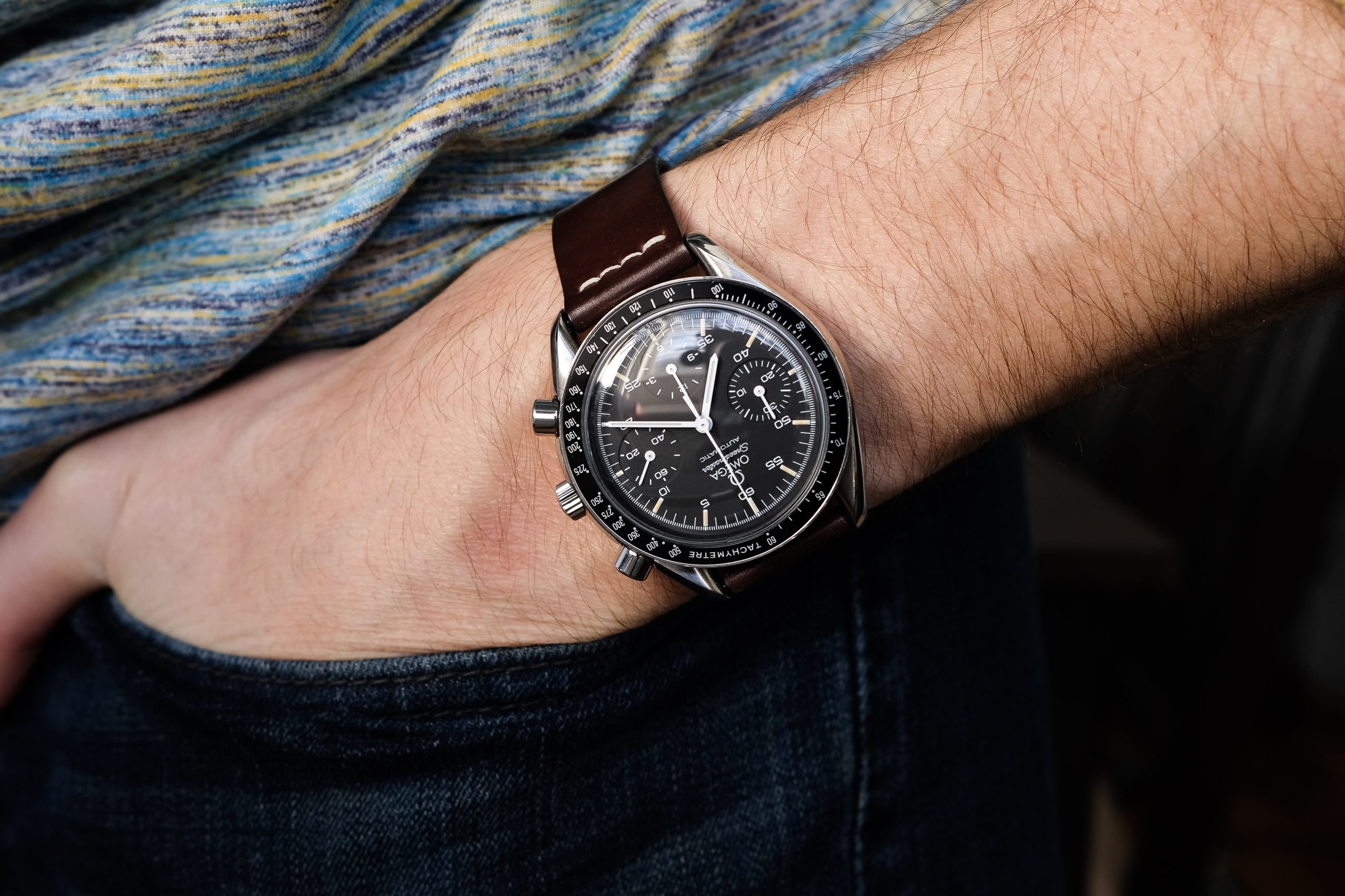
The Watch That Almost Wasn’t Mine
Let me tell you about the moment I nearly walked away from this purchase. I’d been scrolling through forums, reading comment after comment calling the Speedmaster Reduced “not a real Speedmaster” and “a poor man’s Moonwatch.” The internet had almost convinced me to save up for the Professional instead.
Then I tried one on.
My buddy actually laughed when I told him I was buying an omega speedmaster reduced instead of the legendary Moonwatch. Fourteen days later, he’s texting me asking where to find one. This omega speedmaster reduced review comes from genuine daily wear — not a weekend tryout or a quick photo session. I tracked everything: accuracy, comfort, compliments, and annoyances. Here’s what two weeks taught me about one of Omega’s most divisive timepieces.
Specifications at a Glance
Before diving into the experience, here’s what you’re working with on the speedmaster reduced:
- Reference: 3510.50.00 (Hesalite) / 3539.50.00 (Sapphire)
- Case diameter: 38-39mm
- Omega speedmaster reduced lug to lug: 44-45mm
- Thickness: 12mm
- Movement: Caliber 3220 (ETA 2890-A2 + Dubois-Dépraz module)
- Power reserve: 40 hours
- Water resistance: 30m (Hesalite) / 100m (Sapphire)
- Lug width: 18mm
That lug to lug measurement? It’s the secret weapon here. More on that later.
div>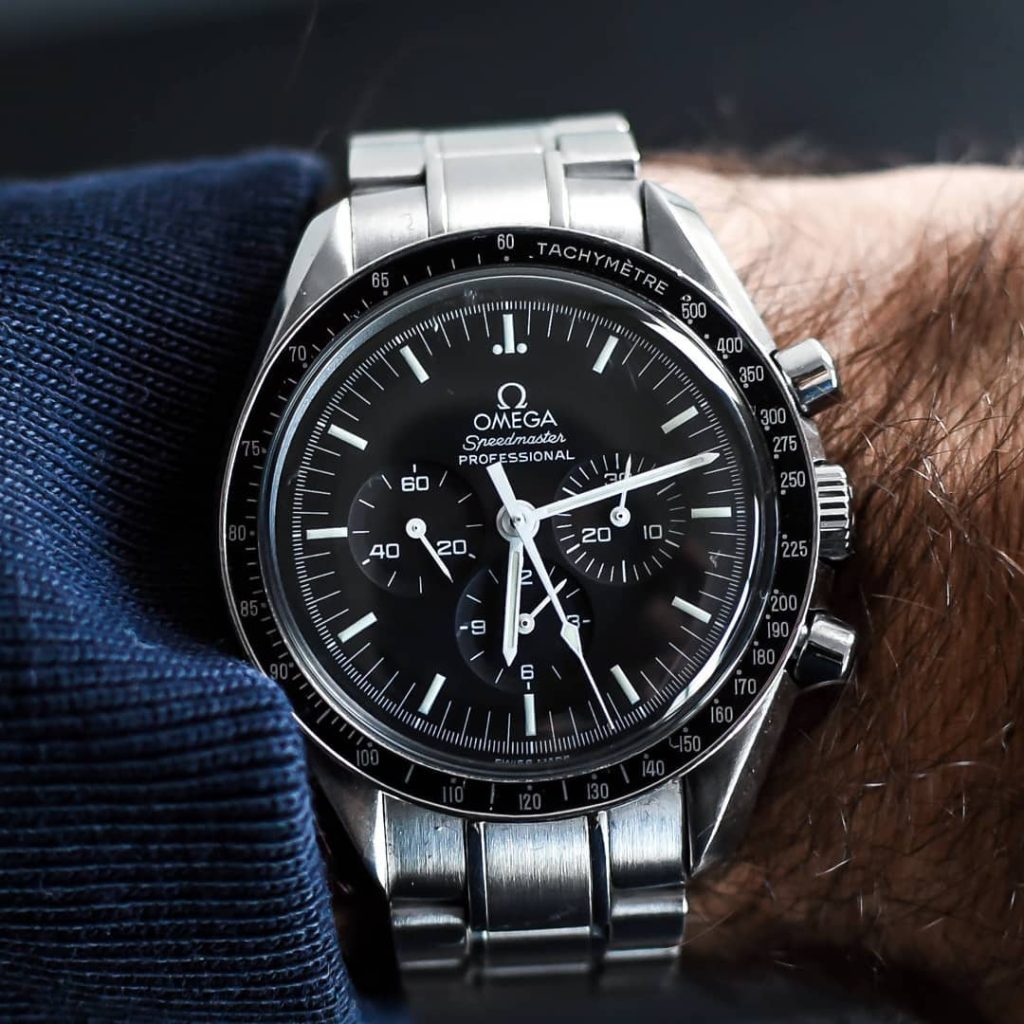
Design and Build Quality
First Impressions Out of the Box
I expected the omega reduced to feel like a budget alternative. Something that would remind me with every glance that I’d “settled.” Instead, when I held it for the first time, the weight felt substantial without being heavy. The brushed surfaces caught the light in a way that screamed quality, not compromise.
The Hesalite crystal on my reference has this beautiful dome that photographs terribly but looks incredible in person. It softens the dial, adds warmth, and gives the whole piece a distinctly vintage character that sapphire simply cannot replicate.
The Case Shape and Finishing
Polished bevels run along the edges while brushed surfaces dominate the tops of the lugs. It’s a combination that creates visual depth without being flashy. The lugs themselves curve gently — less dramatically than the Professional’s aggressive swoops, but elegant in their own right.
Here’s an honest critique: the shorter lugs lack the sharp definition that Speedmaster purists obsess over. Whether that bothers you depends entirely on how much you care about matching the Moonwatch aesthetic. For me? The compact profile won me over.
The Dial — Where Opinions Get Loud
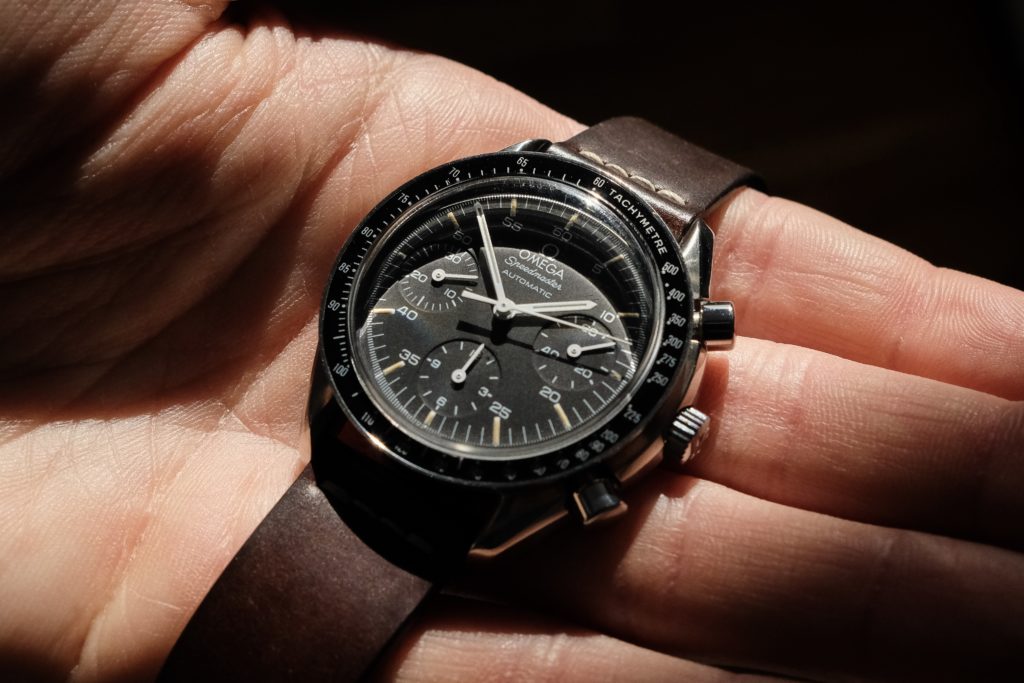
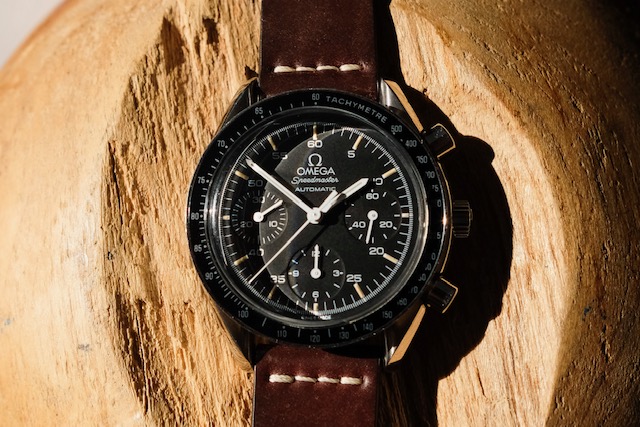
This is where the speedmaster reduced really diverges from its bigger sibling. The subdials push outward, nearly touching the minute track around the perimeter. Running seconds sits at 3 o’clock rather than 9. Arabic numerals mark five-minute intervals on earlier references.
Some collectors hate this layout. They call it unbalanced, cramped, even ugly. After staring at it daily for two weeks, I’ve landed somewhere different. The spread-out registers give the dial energy. It feels sporty, almost racing-inspired, rather than clinical.
Reading the subdials at a glance? That takes practice. In dim lighting, I won’t pretend it’s easy.
Crown and Pusher Offset
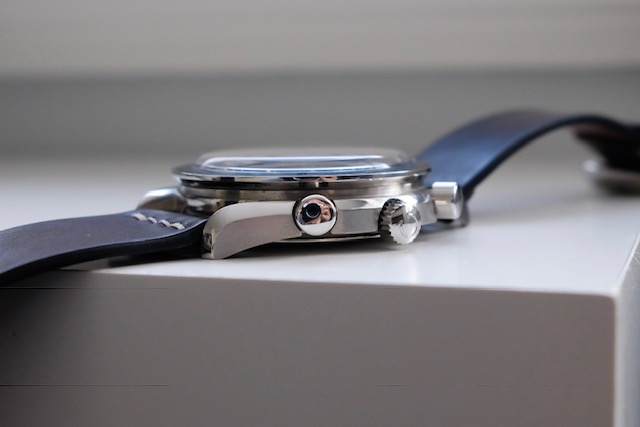
You’ll notice the crown sits lower than the chronograph pushers — a visual quirk that drives some people crazy. This happens because of the modular movement architecture inside. The chronograph mechanism stacks on top of the timekeeping base, so the pushers engage at a higher level.
Honestly, I forgot about it after day three. During normal wear, it’s invisible. Only when photographing the case profile did I notice the offset again.
The Bracelet Experience
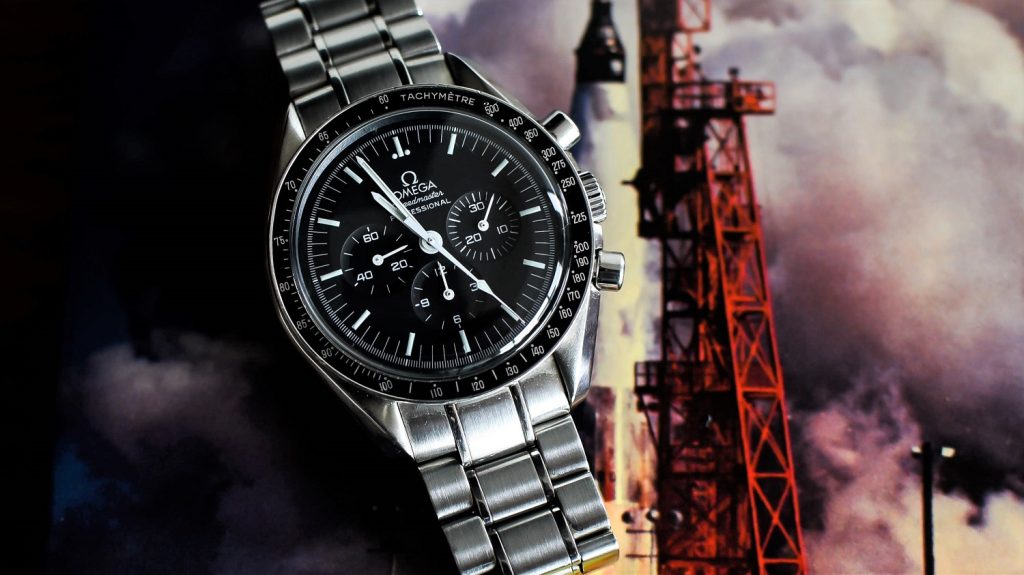
The 18mm lug width threw me initially. It looks narrow compared to the case, and finding aftermarket straps requires slightly more hunting than the standard 20mm options. But the original bracelet itself? Solid. The clasp feels secure without being fussy, and sizing took about ten minutes with a basic spring bar tool.
I threw a vintage-style brown leather strap on it for a weekend trip and the whole character transformed. If you buy this watch, budget for at least one alternative strap. It’s a genuine chameleon.
Movement and Accuracy
The “Controversial” Caliber 3220
Let’s address the elephant directly. The omega speedmaster reduced doesn’t run the legendary hand-wound Caliber 1861 found in the Moonwatch. Instead, Omega used an ETA 2890-A2 base with a Dubois-Dépraz 2020 chronograph module bolted on top.
Purists consider this sacrilege. A “real” chronograph should have an integrated movement, they argue, not a piggyback setup.
My counterpoint? The speedmaster automatic winds itself. No morning ritual required. Grab it, wear it, go. For a daily watch, that convenience matters more than movement pedigree.
Accuracy Over Two Weeks
I tracked this obsessively. Every morning, I compared it against my phone’s atomic-synced clock. The verdict: +4 seconds per day on average. Some days it gained 3, others pushed to 6, but it settled around that +4 mark consistently.
Not COSC-certified territory, but absolutely acceptable for a chronograph in this price range. I never felt the need to adjust it during the entire fourteen days.
Chronograph Function in Practice
The pushers feel crisp. Starting the chronograph produces a satisfying click, and the reset snaps the seconds hand back to twelve with precision. No stuttering, no misalignment.
Did I actually use the function? More than expected. Timing coffee brews became a morning ritual. Parking meters. Cooking intervals. Once you have a working chronograph on your wrist, you find excuses to use it.
Servicing Realities
Here’s where I’ll give an honest warning. Modular movements can be trickier to service than integrated ones. Some independent watchmakers prefer replacing the entire chronograph module rather than repairing it. Costs run comparable to a full Moonwatch service through Omega — roughly $750-900 depending on what’s needed.
Factor servicing into your ownership expectations. This isn’t a “buy and forget” piece.
Wearability and Comfort
Size Matters — The Lug-to-Lug Advantage
The omega speedmaster reduced lug to lug measurement sits at 44-45mm. Compare that to the Professional’s 47.5mm span, and you’ll understand why this watch works on wrists that the Moonwatch overwhelms.
My wrists measure 6.75 inches. The Professional always hung over the edges, creating that awkward “watch on a dinner plate” look. The omega speedmaster reduced on wrist? Sits perfectly inside the wrist bones. No overhang. No weird angles. Just clean lines from every direction.
If your wrists fall under 7 inches, the lug to lug omega reduced offers might be the deciding factor.
Daily Wear Report
Two weeks of genuine daily abuse:
Desk work: Zero sleeve catches. The 12mm thickness slides under cuffs without drama. Typing for hours produced no discomfort — the bracelet adjusts well for keyboard positioning.
Active wear: Wore it to the gym twice. No complaints. The crown guards protect against accidental pusher activation, and the moderate water resistance handles sweat without issue.
Dressy occasions: Here’s where I got surprised. Wore it to a client dinner with a navy suit. Nobody asked if it was real. Three people asked if it was vintage. That felt like a win.
Weight Distribution
The 12mm thickness combined with a 39mm diameter creates slightly chunky proportions. It doesn’t wear as slim as you might expect from the case dimensions. Not uncomfortable — just noticeable when comparing against flatter dress watches in my collection.
Speedmaster Reduced on Wrist — The Visual Reality
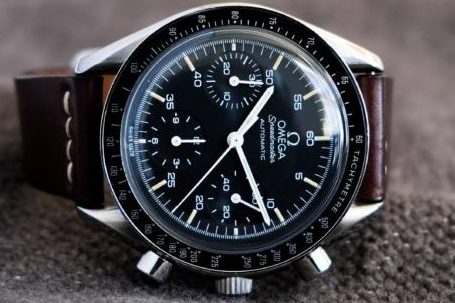
Photos never capture what Hesalite does to light. In pictures, the dial looks flat. In person, the domed crystal creates depth, almost like looking through a window rather than at a surface. The omega speedmaster reduced on wrist photographs smaller than it appears, which sounds backwards but proves true consistently.
Speedmaster Reduced vs Professional — My Take
What You’re Actually Choosing Between
This speedmaster reduced vs professional debate gets framed as “real vs fake” in online forums. That’s nonsense. You’re choosing between:
- Manual winding ritual vs automatic convenience
- 42mm presence vs 39mm versatility
- Integrated chronograph movement vs modular setup
- Moon landing heritage vs everyday practicality
- $6,000+ pricing vs $2,500-4,000 range
Both are legitimate Omega chronographs. Different tools for different priorities.
When the Reduced Makes More Sense
The omega speedmaster reduced vs professional question tilts toward the Reduced when:
- Your wrists measure under 7 inches
- Daily wearing without winding appeals to you
- Budget constraints exist but Speedmaster DNA matters
- Vintage proportions attract you more than modern sizing
- You want a watch to use, not display
When the Professional Is Better
The speedmaster professional vs reduced comparison favors the Moonwatch when:
- Apollo history and NASA certification matter deeply
- Your wrist size accommodates 42mm comfortably
- Investment and resale value drive decisions
- Integrated movement architecture is non-negotiable
- The manual winding experience appeals rather than annoys
My Verdict After Handling Both
I’ve tried the Professional multiple times. It’s objectively the more important watch — historically, mechanically, culturally. But the omega speedmaster professional vs reduced question isn’t about objective superiority.
The Professional is the better watch on paper. The speedmaster vs reduced debate ends differently when I look at MY wrist. There, the Reduced wins every time.
Price and Value Proposition
Current Market Pricing
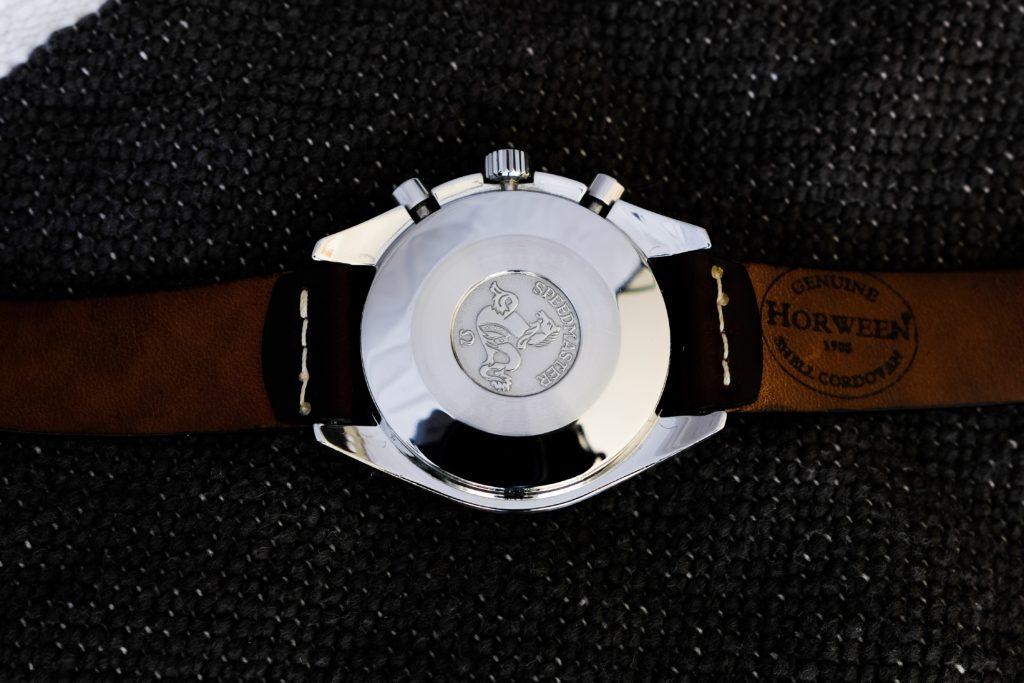
Since Omega discontinued the line in 2009, you’re shopping pre-owned exclusively. Current omega speedmaster reduced price ranges:
- Ref. 3510.50.00 (Hesalite): $2,300-3,500
- Ref. 3539.50.00 (Sapphire): $4,000-5,500
- Schumacher editions: $3,500-6,000+
- Gold or two-tone variants: $5,000-8,000+
Condition matters enormously. Service history matters even more.
What Affects Pricing
The omega speedmaster reduced price fluctuates based on:
- Complete box and papers (adds $300-500)
- Recent service documentation (critical for modular movements)
- Original bracelet condition (18mm replacements are scarce)
- Dial variant and reference rarity
Competitors at Similar Price Points
For $3,000-4,000, you could also consider:
- Tudor Black Bay Chrono: Larger at 41mm, in-house movement, ~$4,500 new
- TAG Heuer Carrera: Modern styling, ~$5,500 new
- Longines Master Collection Chrono: Column-wheel movement, ~$3,200 new
None carry the Speedmaster name. None have that specific design heritage. For my money, the omega reduced offers unmatched value in this segment.
Investment Potential
Prices have climbed steadily since discontinuation. Not Moonwatch appreciation levels, but solid 5-8% annual gains on clean examples. My honest advice? Buy it to wear. If it appreciates, that’s a bonus — not the goal.
What I Loved
The lug-to-lug measurement changed everything. After years of fighting oversized chronographs, finding one that fits properly felt revelatory. The 44mm span works on wrists that most sport watches overwhelm.
Automatic winding removes daily friction. Grab it from the watch box, strap it on, leave. No winding routine. No power reserve anxiety. Just wear.
The design DNA is unmistakably Speedmaster. Tachymeter bezel. Three-register layout. Twisted lugs. From three feet away, nobody questions what family this belongs to.
Compliment magnet status confirmed. Three people commented during week one alone. At a birthday party, a guy wearing a Rolex Daytona grabbed my wrist and said, “This is what I actually want to wear daily.” That moment stuck with me.
Strap versatility exceeded expectations. Brown leather for weekends. Black rubber for workouts. NATO for casual Fridays. Every combination worked.
What Could Be Better
The 18mm lug width limits options. Most quality straps come in 20mm standard. Finding excellent 18mm alternatives requires patience and hunting.
Servicing headaches are real. Modular movements frustrate some watchmakers. Finding someone comfortable with the Dubois-Dépraz module adds complexity to ownership.
The chronograph hand lacks luminous treatment. In low light, reading elapsed seconds becomes guesswork. The hour and minute hands glow fine, but that central chrono hand disappears.
Dial proportions feel cramped at times. With subdials pushed toward the edges, the center can look sparse while the perimeter feels crowded. Your eyes adjust, but initial impressions may be mixed.
It lives in the Moonwatch’s shadow permanently. Every conversation involves explaining why you didn’t buy the Professional. That gets tiring, even when you’re confident in your choice.
Real Moments — Stories from Two Weeks
The Compliment That Surprised Me
Day four. Coffee shop. The barista looked at my wrist while handing over my Americano and said, “That’s beautiful. My grandfather had one.” She meant a Speedmaster generally — probably the Professional — but the sentiment landed. Something about this design triggers emotional responses in people who don’t even care about watches.
The Lume Test
I woke at 3 AM during week two, disoriented from a weird dream. Glanced at my wrist instinctively. The hands glowed strong enough to read clearly without reaching for my phone. Not Seiko diver levels of brightness, but genuinely functional. Better than expected.
The One Annoyance
Driving home from dinner, I tried reading the 30-minute register to check elapsed time on the chronograph I’d started earlier. Bad idea. The subdial is small, the lighting was dim, and my eyes aren’t getting younger. I nearly missed my exit squinting at it.
When It Felt Perfect
Saturday morning. Coffee run. Vintage brown strap installed the night before. Sunlight hitting the dial through my windshield at a perfect angle. The Hesalite crystal caught that light and made the black dial glow from within. That moment — that’s when I stopped questioning my purchase entirely.
Who Should Buy This Watch?
Speedmaster lovers with smaller wrists: The Professional overwhelms you? The Reduced won’t. That simple.
Daily-wear enthusiasts: You want a chronograph that works for you, not one you work for. Automatic winding delivers that.
Budget-conscious collectors: Entry to the Speedmaster world without Moonwatch pricing. Same brand. Same heritage. Different bank impact.
Vintage aesthetic seekers: The Hesalite crystal and compact sizing channel 1970s cool. Modern alternatives can’t replicate that vibe.
Skip it if: Moon landing provenance is mandatory for you. Or if 42mm fits your wrist better. Or if modular movements genuinely bother you. No shame in any of those preferences.
Where It Stands Now
The watch is on my wrist as I type this. That probably tells you everything about where I landed. Will it replace my other pieces permanently? No — variety matters. But does it earn regular rotation? Absolutely.
Would I buy it again knowing everything I know now? Every single time. The speedmaster reduced isn’t trying to be the Moonwatch. It’s trying to be a fantastic daily chronograph from a legendary brand at an accessible price point. On those terms, it succeeds completely.
My buddy still texts me about finding one. Last week, he finally pulled the trigger on a clean 3510.50. His first message after it arrived? “I get it now.”
Yeah. You will too.